Daily Dictation 50
本篇对话来源: https://www.youtube.com/watch?v=BFx755QeJME
听写记录 :
背景介绍:
DD50 uses a British accent, from a 4 min film. The words or the speed are not sure.
听写部分:
(本次听力有 30 秒,但只需要听写最后两个句子即可)
I know its... actually, but its... fancy.
→ 【边听边记】 Why do you want to get there? I know it's hard to ..., but it's the place which will take my fancy.
- 【然后完善】
Why do you want to get there?
I know it's hard to believe it, but it's the place which will take my fancy.
→ 【边听边记】 presh, recently? - 【然后完善】
Why do you want to get there?
I know it's hard to presh recently, but it's the place which will take my fancy.
→ 【边听边记】 appreciate? resonably? - 【然后完善】
Why do you want to get there?
I know it's hard to appreciate it resonably, but it's the place will take my fancy.
句子理解:
我的理解是:
你为什么要去那儿(美国)?
我知道这很难去理解,但那是一个让我中意的地方。
批改 :
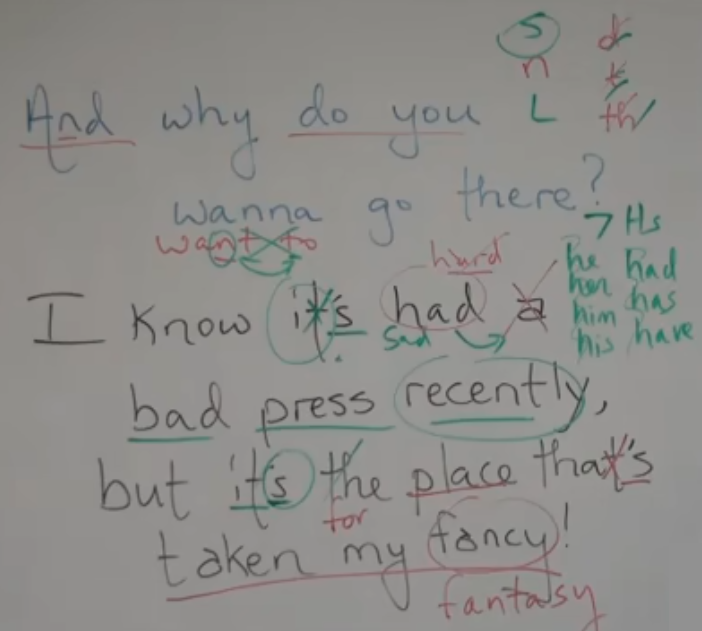
【And】 Why do you want to get 【wanna go】 there?
I know it's hard to appreciate it resonably 【had a bad press recently】, but it's the place will take 【that's taken】 my fancy.
错误原因 :
句子的词汇都认识,但句子的意思理解上有比较多的偏差。开头的 /n/ 音没有意识到是 and。
have a bad press 不熟悉
笔记 :
词汇 :
bad press → 有很多负面报道,press 有新闻的意思。
take one's fancy → fond of,... 让某人喜爱
- 注意,that's taken 是 that has taken 的缩写; 同样地,在前面,it's 是 it has 的缩写。由于 that's 也可以是 that is 的缩写,因此需要根据语境来判断。
fantasy 是幻想的意思
发音 :
/s/ /n/ /l/ 是强音,如果前后跟着 /d/ /t/ 或 th (/θ/ 或 /ð/)的音,则只发强音,后三个不发音。
比如 it's、recently
7Hs:在句子中,这七个 h 开头的单词通常开头的 /h/ 会比较弱,处于句子中时会不发音:
he her his him had has have
it's had → /'ɪsæd/ 或 /'ɪtsæd/
正确答案 :
听完讲解后,根据两遍录音再次听写出正确答案。
- And why do you wanna go there?
- I know it's had a bad press recently, but it's the place that's taken my fancy.
翻译: - 你为什么想去那里?
- 我知道它最近风评不好,但那里偏偏让我着迷。
知晓答案后再听再分析
大人的句子我都能听清楚了,但是那个小孩的发音真是让人头疼。
- 首先,press 发音像是 presh,末尾本来应该是
/s/的音,他说起来像是/ʃ/; - 其次,原先我是根据 place 判断出前面是 the 的,但听老师说有些人写成 for 后,我就代入听了一下,确确实实非常像 for。我猜测应该是小孩发音的时候嘴唇动作幅度比较小,而 for 和 the 的末尾音都是
/ə/,所以些微的咬唇都会让发音听起来像是 for。 - place that's 听起来像是 place what's,从语法上看,what's 肯定是错的,我相信是那个小孩语法没学好。
句子节奏
句子中箭头含义
为了把握长句子的节奏,自己总结了一些用箭头分隔句子,表示音调的方法(供参考,大家可以创造适用于自己的):
- 句子开头的音调以中等音调开始,不高不低;
- → 表示箭头前方的部分音调不变化;
- ↗ 表示在箭头前一个单词处音调上升到最高;
- ↘ 表示在箭头前一个单词处音调下降到最低;
- ↕ 表示此处停顿一会儿,然后以中等音调开始;
- ↑ 表示先停顿,然后下一个单词以高音调开头;
- ↓ 表示先停顿,然后下一个单词以低音调开头;
句子节奏标定
- And why do you wanna go there(↘)?
- I know it's had a(↗) bad press recently(↘), but it's the place(↗) that's taken my fancy(↘).
老师板书 :